


Talk:Convolution
Add topic| This is the talk page for discussing improvements to the Convolution article. This is not a forum for general discussion of the subject of the article. |
Article policies
|
| Find sources: Google (books · news · scholar · free images · WP refs) · FENS · JSTOR · TWL |
Archives: 1, 2, 3, 4Auto-archiving period: 12 months  |
 | This  level-5 vital article is rated C-class on Wikipedia's content assessment scale. It is of interest to the following WikiProjects: | |||||||||||||||||
| ||||||||||||||||||


Definition of convolution
[edit]The current definition on the page is:
- In mathematics (in particular, functional analysis), convolution is a mathematical operation on two functions (f and g) that produces a third function that expresses how the shape of one is modified by the other.
I think this is a bad definition since the idea of a convolution has nothing to do with function "shape", even from an intuitive perspective. And function "shape" is not a precisely defined concept to begin with. I think my definition which just explains that the operation can represent different things depending on context is much better. For example, the functions might be PDFs in which case convolution is related to adding two independeng RVs. Or the context might be signal processing which is a totally different application and context. Or it could be convolution of a function by a dirac delta, in which case the result is simply the function evaluated at a single point and really has nothing to do with shape. DMH43 (talk) 15:27, 26 December 2023 (UTC)
- I agree with this, using function "shape" is unfortunate for a definition. It could be used as a more visual explanation, aimed at those with only that view/interpretation of a function, but not as a definition.
- The use of "reflected about the y-axis" also reflects (no pun intended) this view, and I think it should be changed to "reflected about the origin" (the 2nd/y-axis is not required for univariate functions, only for visualizing the function shape) except possibly where the 2d/shape view is central to the explanation. ~2026-27517-79 (talk) 15:47, 13 June 2026 (UTC)
- I just realised that the original comment evidently led to a change of the definition, where the shape explanation is not central but an additional explanation from a "graphical view".
- .
- The "issue" regarding the y-axis is still relevant though, perhaps as a testemony of the original graphical view of a function (which is useful, yes, but not essential), and I maintain that it should be changed. ~2026-27517-79 (talk) 16:05, 13 June 2026 (UTC)
- Convolution really does have to do with one shape's modifying the other one. (Or vice versa — it's symmetric.) Suppose that g(x) = 1/10 for 0 ≤ x ≤ 10, and g(x) = 0 otherwise. Then the convolution of f and g will be the running average of f over intervals of length 10. That gives an idea of how each shape can influence the other to produce the convolution. — Preceding unsigned comment added by ~2026-54448-96 (talk) 00:13, 14 October 2026 (UTC)
Code for circular convolution (added 20-May-2024)
[edit]- It is unusual to see actual computer code in an article. I suspect there is a policy about that.
- Thank you for the /* reverse the signal */ code comment, but why only one comment?
- I think it needs an explanation of why one would want to use this program. What is your motivation?
- In my experience, the usual motivation for circular convolution is to exploit the efficiency of the formula:
- implemented with a Fast Fourier transform algorithm. (see Eq.4c at Convolution_theorem#Periodic_convolution)
- And only the non-circular part of the output sequence is actually retained.

Bob K (talk) 13:10, 21 May 2024 (UTC)
- An article like this should not have code. It doesn't help with an understanding of the concepts except for a very few readers. Those special cases can use Google to find code. Johnuniq (talk) 01:38, 22 May 2024 (UTC)
Add time reversal property
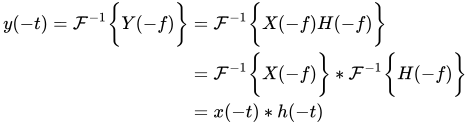
[edit]I'm having difficulties trying to find the time reversal property, and people got it wrong too. If

then

This is the property.
If you look for the property you can find like in this presentation "Signal and Image Analysis, University of Illinois" (PDF)., that they got it wrong, stating that

I would like to propose to add the property so there is no more doubt in this topic. Bouchet07 (talk) 11:27, 25 May 2024 (UTC)
Looks good to me:


What kinds of functions can be convolved?
[edit]Surely, there are some kinds of functions f, g for which the convolution f∗g makes more sense than for others.
Clearly, the integral in the definition of f*g will not necesarily converge.
So: Something should be stated — and above all in the Definition section — that makes it clear which combinations of functions f and g it makes good sense to convolve. (Even if this does not cover all possible cases.)
I hope that someone knowledgeable about this subject can add this to the article where appropriate. ~2026-54448-96 (talk) 00:02, 14 October 2026 (UTC)
"Faltung" listed at Redirects for discussion
[edit] The redirect Faltung has been listed at redirects for discussion to determine whether its use and function meets the redirect guidelines. Readers of this page are welcome to comment on this redirect at Wikipedia:Redirects for discussion/Log/2026 October 14 § Faltung until a consensus is reached. --Bumpf said this! ooh clicky clicky! [insert witty meta-text on wiki-sigs here] 07:46, 14 October 2026 (UTC)