


Talent scheduling

Talent scheduling is a combinatorial optimization problem in computer science and operations research.
Example
[edit]Consider a scenario where multiple films are to be produced, each film contains several scenes, each scene requires one or more actors, and only a single scene can be filmed per day. The salaries of the actors are calculated by the day. In this problem, actors must be employed on consecutive days; for example, an actor cannot be hired on the first and third days only, as the actor would have to be hired on the second day too. During the hiring period, the producers still need to pay the actors even if they are not involved in the filming assignment. The purpose of talent scheduling is to minimize the actors' total salary by adjusting the sequence of scenes.[1]
Mathematical formulation
[edit]Consider a film shoot composed of shooting days and involving a total of actors. Then we use the day out of days matrix (DODM) to represent the requirements for the various shooting days. The matrix with the entry given by:


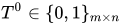


Then we define the pay vector , with the th element given by which means rate of pay per day of the th actor. Let v denote any permutation of the n columns of , we have:



is the permutation set of the n shooting days. Then define to be the matrix with its columns permuted according to , we have:


- for
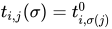

Then we use and to represent denote respectively the earliest and latest days in the schedule determined by a which require actor . So we can find actor will be hired for days. But in these days, only days are actually required, which means days are unnecessary, we have:






The total cost of unnecessary days is:
![{\displaystyle K(\sigma )=\sum _{i=1}^{m}c_{i}h_{i}(\sigma )=\sum _{i=1}^{m}c_{i}[l_{i}(\sigma )-e_{i}(\sigma )+1-\sum _{j=1}^{n}t_{i,j}^{0}]}](https://wikimedia.org/api/rest_v1/media/math/render/svg/d702ec7bbd6c98f97a4ff64cfb786d75a4fd9ca8)
will be the objective function we should minimize.[1]

Proof of strong NP-hardness
[edit]It can be proved that the talent scheduling problem is NP-hard by a reduction to the optimal linear arrangement (OLA) problem.[2] Even if we restrict the problem by requiring that each actor is needed for just two days and all actors' salaries are 1, it's still polynomially reducible to the OLA problem. Thus, this problem is unlikely to have pseudo-polynomial algorithm.[3]
Integer programming
[edit]The integer programming model is given by:[4]
| Minimize | |||
| subject to | |||
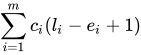
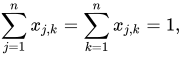

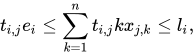



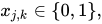

In this model, means the earliest shooting day for talent , is the latest shooting day for talent , is the scheduling for the project, i.e.



References
[edit]- 1 2 Cheng, T. C. E.; Diamond, J. E.; Lin, B. M. T. (1 December 1993). "Optimal scheduling in film production to minimize talent hold cost". Journal of Optimization Theory and Applications. 79 (3): 479–492. doi:10.1007/BF00940554. S2CID 120319128. Retrieved 25 July 2022.
- ↑ Garey, M. R.; Johnson, D. S.; Stockmeyer, L. (1 February 1976). "Some simplified NP-complete graph problems". Theoretical Computer Science. 1 (3): 237–267. doi:10.1016/0304-3975(76)90059-1. ISSN 0304-3975.
- ↑ Garey, M. R.; Johnson, D. S. (1979). Victor Klee (ed.). Computers and Intractability: A Guide to the Theory of NP-Completeness. A Series of Books in the Mathematical Sciences. San Francisco, Calif.: W. H. Freeman and Co. pp. x+338. ISBN 0-7167-1045-5. MR 0519066.
- ↑ Close Kochetov, Y. (2011). Iterative local search methods for the talent scheduling problem. In Proceedings of 1st international symposium and 10th Balkan conference on operational research, September 22, Thessaloniki, Greece (pp. 282–288).