


Table of thermodynamic equations
| Thermodynamics |
|---|
 |






Common thermodynamic equations and quantities in thermodynamics, using mathematical notation, are as follows:
Definitions
[edit]Many of the definitions below are also used in the thermodynamics of chemical reactions.
General basic quantities
[edit]| Quantity (common name/s) | (Common) symbol/s | SI unit | Dimension |
|---|---|---|---|
| Number of molecules | N | 1 | 1 |
| Amount of substance | n | mol | N |
| Temperature | T | K | Θ |
| Heat Energy | Q, q | J | ML2T−2 |
| Latent heat | QL | J | ML2T−2 |
General derived quantities
[edit]| Quantity (common name/s) | (Common) symbol/s | Defining equation | SI unit | Dimension |
|---|---|---|---|---|
| Thermodynamic beta, inverse temperature | β | J−1 | T2M−1L−2 | |
| Thermodynamic temperature | τ |
|
J | ML2T−2 |
| Entropy | S |
, |
J⋅K−1 | ML2T−2Θ−1 |
| Pressure | P |
|
Pa | ML−1T−2 |
| Internal Energy | U | J | ML2T−2 | |
| Enthalpy | H | J | ML2T−2 | |
| Partition Function | Z | 1 | 1 | |
| Gibbs free energy | G | J | ML2T−2 | |
| Chemical potential (of component i in a mixture) | μi |
, where is not proportional to because depends on pressure. , where is proportional to (as long as the molar ratio composition of the system remains the same) because depends only on temperature and pressure and composition. |
J | ML2T−2 |
| Helmholtz free energy | A, F | J | ML2T−2 | |
| Landau potential, Landau free energy, Grand potential | Ω, ΦG | J | ML2T−2 | |
| Massieu potential, Helmholtz free entropy | Φ | J⋅K−1 | ML2T−2Θ−1 | |
| Planck potential, Gibbs free entropy | Ξ | J⋅K−1 | ML2T−2Θ−1 | |









Thermal properties of matter
[edit]| Quantity (common name/s) | (Common) symbol/s | Defining equation | SI unit | Dimension |
|---|---|---|---|---|
| General heat/thermal capacity | C | J⋅K−1 | ML2T−2Θ−1 | |
| Heat capacity (isobaric) | Cp | J⋅K−1 | ML2T−2Θ−1 | |
| Specific heat capacity (isobaric) | Cmp | J⋅kg−1⋅K−1 | L2T−2Θ−1 | |
| Molar specific heat capacity (isobaric) | Cnp | J⋅K−1⋅mol−1 | ML2T−2Θ−1N−1 | |
| Heat capacity (isochoric/volumetric) | CV | J⋅K−1 | ML2T−2Θ−1 | |
| Specific heat capacity (isochoric) | CmV | J⋅kg−1⋅K−1 | L2T−2Θ−1 | |
| Molar specific heat capacity (isochoric) | CnV | J⋅K⋅−1 mol−1 | ML2T−2Θ−1N−1 | |
| Specific latent heat | L | J⋅kg−1 | L2T−2 | |
| Ratio of isobaric to isochoric heat capacity, heat capacity ratio, adiabatic index, Laplace coefficient | γ | 1 | 1 | |


Thermal transfer
[edit]| Quantity (common name/s) | (Common) symbol/s | Defining equation | SI unit | Dimension |
|---|---|---|---|---|
| Temperature gradient | No standard symbol | K⋅m−1 | ΘL−1 | |
| Thermal conduction rate, thermal current, thermal/heat flux, thermal power transfer | P | W | ML2T−3 | |
| Thermal intensity | I | W⋅m−2 | MT−3 | |
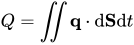
| Thermal/heat flux density (vector analogue of thermal intensity above) | q | W⋅m−2 | MT−3 | |


Equations
[edit]The equations in this article are classified by subject.
Thermodynamic processes
[edit]| Physical situation | Equations |
|---|---|
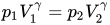
| Isentropic process (adiabatic and reversible) |
For an ideal gas |
| Isothermal process |
For an ideal gas |
| Isobaric process | p1 = p2, p = constant |
| Isochoric process | V1 = V2, V = constant |
| Free expansion | |
| Work done by an expanding gas | Process
Net work done in cyclic processes |




Kinetic theory
[edit]| Physical situation | Nomenclature | Equations |
|---|---|---|
| Ideal gas law |
|
|
| Pressure of an ideal gas |
|
|


Ideal gas
[edit]| Quantity | General Equation | Isobaric Δp = 0 |
Isochoric ΔV = 0 |
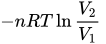
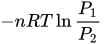
Isothermal ΔT = 0 |
Adiabatic |
|---|---|---|---|---|---|
| Work W |
|
||||
| Heat Capacity C |
(as for real gas) | (for monatomic ideal gas)
|
(for monatomic ideal gas)
|
||
| Internal Energy ΔU |
|||||
| Enthalpy ΔH |
|||||
| Entropy Δs |
[1] |
||||
| Constant |









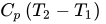


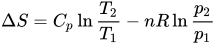


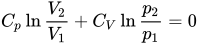


Entropy
[edit]- , where kB is the Boltzmann constant, and Ω denotes the volume of macrostate in the phase space or otherwise called thermodynamic probability.
- , for reversible processes only


Statistical physics
[edit]Below are useful results from the Maxwell–Boltzmann distribution for an ideal gas, and the implications of the Entropy quantity. The distribution is valid for atoms or molecules constituting ideal gases.
| Physical situation | Nomenclature | Equations |
|---|---|---|
| Maxwell–Boltzmann distribution |
K2 is the modified Bessel function of the second kind. |
Non-relativistic speeds
Relativistic speeds (Maxwell–Jüttner distribution) |
| Entropy Logarithm of the density of states |
|
where: |
| Entropy change | ||
| Entropic force | ||
| Equipartition theorem | df = degree of freedom | Average kinetic energy per degree of freedom
Internal energy |





Corollaries of the non-relativistic Maxwell–Boltzmann distribution are below.
| Physical situation | Nomenclature | Equations |
|---|---|---|
| Mean speed | ||
| Root mean square speed | ||
| Modal speed | ||
| Mean free path |
|
|


Quasi-static and reversible processes
[edit]For quasi-static and reversible processes, the first law of thermodynamics is:

where δQ is the heat supplied to the system and δW is the work done by the system.
Thermodynamic potentials
[edit]The following energies are called the thermodynamic potentials,
| Name | Symbol | Formula | Natural variables |
|---|---|---|---|
| Internal energy | |||
| Helmholtz free energy | |||
| Enthalpy | |||
| Gibbs free energy | |||
| Landau potential, or grand potential |
, |

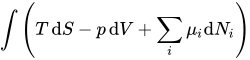





and the corresponding fundamental thermodynamic relations or "master equations"[2] are:
| Potential | Differential |
|---|---|
| Internal energy | |
| Enthalpy | |
| Helmholtz free energy | |
| Gibbs free energy | |




Maxwell's relations
[edit]The four most common Maxwell's relations are:
| Physical situation | Nomenclature | Equations |
|---|---|---|
| Thermodynamic potentials as functions of their natural variables |
| |


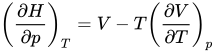
More relations include the following.
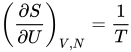
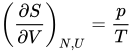
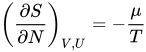
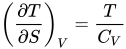

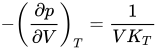
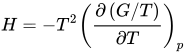
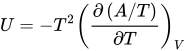
Other differential equations are:
| Name | H | U | G |
|---|---|---|---|
| Gibbs–Helmholtz equation | |||

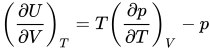
Quantum properties
[edit]- Indistinguishable Particles


where N is number of particles, h is that Planck constant, I is moment of inertia, and Z is the partition function, in various forms:
| Degree of freedom | Partition function |
|---|---|
| Translation | |
| Vibration | |
| Rotation |
|


Thermal properties of matter
[edit]| Coefficients | Equation |
|---|---|
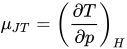
| Joule-Thomson coefficient | |
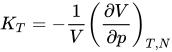
| Compressibility (constant temperature) | |
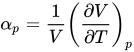
| Coefficient of thermal expansion (constant pressure) | |
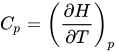
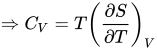
| Heat capacity (constant pressure) | |
| Heat capacity (constant volume) | |


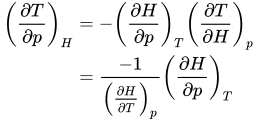
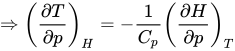
| Derivation of heat capacity (constant pressure) |
|---|
|
Since |

| Derivation of heat capacity (constant volume) |
|---|
|
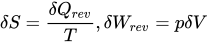
Since (where δWrev is the work done by the system), |



Thermal transfer
[edit]| Physical situation | Nomenclature | Equations |
|---|---|---|
| Net intensity emission/absorption |
|
|
| Internal energy of a substance |
|
|
| Meyer's equation |
|
|
| Effective thermal conductivities |
|
Series
Parallel |





Thermal efficiencies
[edit]| Physical situation | Nomenclature | Equations |
|---|---|---|
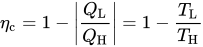
| Thermodynamic engines |
|
Thermodynamic engine:
Carnot engine efficiency: |
| Refrigeration | K = coefficient of refrigeration performance | Refrigeration performance
Carnot refrigeration performance |



See also
[edit]- List of thermodynamic properties
- Antoine equation
- Bejan number
- Bowen ratio
- Bridgman's equations
- Clausius–Clapeyron relation
- Departure functions
- Duhem–Margules equation
- Ehrenfest equations
- Gibbs–Helmholtz equation
- Phase rule
- Kopp's law
- Noro–Frenkel law of corresponding states
- Onsager reciprocal relations
- Stefan number
- Thermodynamics
- Timeline of thermodynamics
- Triple product rule
- Exact differential
References
[edit]- ↑ Keenan, Thermodynamics, Wiley, New York, 1947
- ↑ Physical chemistry, P.W. Atkins, Oxford University Press, 1978, ISBN 0 19 855148 7
- Atkins, Peter and de Paula, Julio Physical Chemistry, 7th edition, W.H. Freeman and Company, 2002 ISBN 0-7167-3539-3.
- Chapters 1–10, Part 1: "Equilibrium".
- Bridgman, P. W. (1 March 1914). "A Complete Collection of Thermodynamic Formulas". Physical Review. 3 (4). American Physical Society (APS): 273–281. Bibcode:1914PhRv....3..273B. doi:10.1103/physrev.3.273. ISSN 0031-899X.
- Landsberg, Peter T. Thermodynamics and Statistical Mechanics. New York: Dover Publications, Inc., 1990. (reprinted from Oxford University Press, 1978).
- Lewis, G.N., and Randall, M., "Thermodynamics", 2nd Edition, McGraw-Hill Book Company, New York, 1961.
- Reichl, L.E., A Modern Course in Statistical Physics, 2nd edition, New York: John Wiley & Sons, 1998.
- Schroeder, Daniel V. Thermal Physics. San Francisco: Addison Wesley Longman, 2000 ISBN 0-201-38027-7.
- Silbey, Robert J., et al. Physical Chemistry, 4th ed. New Jersey: Wiley, 2004.
- Callen, Herbert B. (1985). Thermodynamics and an Introduction to Themostatistics, 2nd edition, New York: John Wiley & Sons.